

Detailed Description of the Idea
This is a detailed description of the idea. There is also a a briefer description and a a slideshow presentation on the process.
A Concept Process for the Sequestration of Carbon Dioxide, the Mitigation of Ocean Acidification and the Production of Biomass in Arid Environments
Abstract
The concept process outlined has the potential to reduce the concentration of carbon dioxide in the atmosphere to pre-industrial levels. The process works by thermally decomposing (calcining) limestone and adding the resulting calcium oxide to seawater, thereby increasing the capacity of the oceans to act as a carbon sink, whilst at the same time mitigating ocean acidification. The carbon dioxide generated by the thermal decomposition (calcination) of limestone can be sequestered, or utilized either as the starting point for the production of fuels, or to enable biomass to be grown in arid environments, without the need for irrigation. The process thus addresses a number of environmental and social problems: climate change, ocean acidification, food shortages, fuel shortages, water shortages and soil salinification from excessive irrigation.
Introduction
The world’s oceans act as a carbon sink absorbing about 2 billion tonnes of carbon (2GtC) from the atmosphere each year, thereby helping to slow the rate of increase in the concentration of atmospheric carbon dioxide. Whilst this helps slow climate change, the additional carbon dioxide dissolving in seawater causes ocean acidification – a reduction in the pH of the oceans, which threatens the viability of marine biosystems.
The concept process outlined in this paper seeks to simultaneously enhance the capacity of the oceans to act as a carbon sink and to mitigate ocean acidification, by adding calcium oxide to seawater. The source of the calcium oxide is limestone. By heating limestone until it thermally decomposes, calcium oxide and carbon dioxide are generated. On addition to seawater the calcium oxide reacts with carbon dioxide dissolved in the water to generate calcium bicarbonate solution.
The key aspect of the concept process is that each mol of calcium oxide acts to enhance the capacity of the oceans to absorbs two mols of carbon dioxide from the atmosphere at dilute concentrations (387ppm), whilst, to produce the calcium oxide, only one mol of pure carbon dioxide is generated.
Pure carbon dioxide has several advantageous properties that carbon dioxide at atmospheric concentrations does not have – it is easier to sequestrate, it can be used as a feedstock for the production of fuels and it allows the production of biomass in arid environments.
Utilizing this ‘carbon negative’ process has the potential to reverse the accumulation of carbon dioxide in the atmosphere and it would be possible to reduce atmospheric carbon dioxide levels to pre-industrial levels.
Origination of the Idea
Whilst this idea was developed independently, it has recently been brought to our attention that a very similar idea was put forward in a paper by Haroon Kheshgi in 1995 (Kheshgi HS “Sequestering atmospheric carbon dioxide by increasing ocean alkalinity”, 1995, Energy 20, 915-922). He concluded that “this approach appears to be limited only by the availability of energy” – it is this constraint that we are hoping that we are able to address.
The concept of using carbon dioxide generated from the calcination of limestone to enable the production of biomass in arid environments is, as far as we are aware, original.
Calcinination of Limestone
It seems counter-intuitive to attempt to counter climate change by heating limestone. For a start the process is highly energy-intensive – to calcine limestone requires a temperature of 850C and consumes 2.67GJ per tonne of limestone calcined. Also, when the limestone (CaCO3) decomposes it generates carbon dioxide:

So it is doubly damaging – the energy-intensive process results in carbon dioxide production (assuming fossil fuels are used to drive the reaction) and carbon dioxide is emitted as a product of the process.
In order to derive pure carbon dioxide from the calcination of limestone it will not be possible to use conventional lime kilning processes as these co-fire fuel, air and limestone, resulting in a flue gas which contains large quantities of nitrogen. Instead one of two novel techniques will need to be employed:
- Co-firing fuel, oxygen and limestone in a conventional kiln. (It may be necessary to dilute the fuel oxygen mix with carbon dioxide, which will lower the burn temperature that would otherwise result – if the temperature is too high, the calcium oxide generated will sinter)
- Separating the heating process from the calcining process. A fluid, potentially molten iron or water vapour, is heated within a sealed vessel by the combustion of the fuel in air external to the sealed vessel. The limestone is calcined in or on the heated fluid. The flue gases of the two processes (combustion and calcination) are treated separately with the flue gas from combustion having a low carbon dioxide content, whilst the flue gas from the calcination is pure carbon dioxide.
Addition of Calcium Oxide to Seawater
If, however, the calcium oxide generated is added to seawater (either directly, or more probably, first reacted with water to form calcium hydroxide) then it reacts with carbon dioxide dissolved in the seawater to produce calcium bicarbonate:

Note that at the pH levels present in seawater, the bicarbonate ion (HCO3-) is by far the dominant ion formed, rather than the carbonate ion (CO32-). Thus for every mol of carbon dioxide generated from the calcination of limestone, approximately 1.79 mols of carbon dioxide are sequestered when the calcium oxide is added to seawater, a net sequestration of 0.79 mols of carbon dioxide. The exact amount of carbon dioxide sequestered will depend upon the exact conditions (including pH, temperature and pressure) where the reaction takes place.
The addition of calcium oxide to seawater leads to the sequestration of carbon dioxide, by enhancing the capacity of the oceans to act as a carbon sink. It does this by shifting the series of equilibria (below) to the right, thereby increasing the capacity of seawater to absorb carbon dioxide from the atmosphere and by decreasing the propensity for seawater to desorb carbon dioxide into the atmosphere.

At the same time as sequestering carbon dioxide, the addition of calcium oxide to seawater will cause the pH to increase, thereby mitigating ocean acidification. Care will need to be taken to ensure that the way in which the calcium oxide is added to the seawater does not lead to excessive localised increases in pH.
Treatment of Carbon Dioxide
There are several options for treating the carbon dioxide generated from the calcining of limestone:
- The first option is to simply release it into the atmosphere. This may seem counter-productive – we are after all trying to remove CO2 from the atmosphere – but given that adding calcium oxide to seawater removes nearly twice as much CO2 as is generated in the calcining process, this may be the most economic route.
- The second option is to sequester the carbon dioxide using existing techniques (e.g. in saline aquifers, disused oil wells, etc). It should be noted that the costs associated with the sequestration of carbon dioxide from the flue gases of a fossil fuel power plant are primarily associated with the separation out of carbon dioxide from the other flue gases and the cost of sequestering the pure carbon dioxide are low in comparison. The carbon dioxide generated from the calcining of limestone will be relatively pure and no separation will need to be undertaken.
- The third option is to use the pure source of carbon dioxide as a starting point for the production of fuels. Various techniques are already known, whereby with the addition of heat energy, carbon dioxide can be split into carbon monoxide and oxygen:

Carbon monoxide can be reacted with water to produce hydrogen using the gas shift reaction:

This hydrogen could be used as a fuel in itself, or as a starting product for the production of other chemicals including hydrocarbon fuels by reacting it with carbon monoxide derived from the previous reaction in Fischer-Tropsch reactions.
Alternatively the carbon monoxide could be dissociated into carbon and carbon dioxide via the Boudouard Reaction:
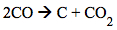
The carbon yielded could either be sequestered (by burying) or could be used as a fuel in conventional coal-fired power stations. The carbon produced would be of greater purity than coal as it would not contain pollutants such as sulfur and heavy metals.
- The fourth option is to use the carbon dioxide to enable biomass to be grown in arid environments, without the need for irrigation. Carbon dioxide is introduced into a transparent, sealed vessel which is filled with water and contains algae where photosynthesis will occur in the presence of sunlight.
nCO2 + nH2O –> (CH2O)n + nO2
Carbon dioxide and water are converted into sugars and oxygen.
Because the system is sealed, water loss will be minimal. One potential source of water loss could occur when the oxygen generated during photosynthesis is vented from the system – it is necessary to vent the oxygen to avoid a build-up of pressure. If water is particularly scarce it may make economic sense to dry the vented oxygen to recover any water vapour from it. Note that were ambient air containing carbon dioxide at 387ppm used instead of pure carbon dioxide, over 2500 times the volume of gas would need to be dried to deliver the same amount of carbon dioxide, without the loss of water vapour.
The production of one mol of glucose (C6H12O6) (180g) involves the consumption of six mols of water (108g). Thus for each kg of glucose produced 600g of water are consumed.
Were such a system to yield 10 tonnes of glucose per hectare per year (comparable to the yield of a conventional sugar cane plantation), then 6 tonnes of water would be consumed. As a single millimetre of rain falling on a hectare amounts to 10 tonnes of water, it can be seen that such a system could allow the production of crops in all but the most arid of environments, even allowing for the loss of some water from the system (cf the average annual precipitation in the most arid parts of the Sahara is 40mm per year).
In comparison, to grow crops in arid environments using conventional irrigation often uses over 1000 tonnes of water per tonne of dry crop yielded.
The crops yielded could be used for human or animal consumption, or be utilised to produce biofuels. It could be possible to have algae photosynthesizing at the top of the vessel (in the sunlight) and dead algae falling to the bottom of the vessel, where they would be decomposed by bacteria in anoxic conditions to yield methane which would be combusted with the oxygen vented from the system to provide the heat energy required to drive the calcination of limestone.
In addition to lacking water, deserts are often hostile environments for plant life because they suffer from extreme temperature swings. Night-time temperatures can be close to freezing point and peak day-time temperatures can cause scorching. Having a large body of water in a sealed container provides a high heat capacity, resulting in less dramatic fluctuations in temperature. This would allow the system to operate at a temperature that is more amenable to plant growth throughout the day. Normally, employing large quantities of water in a desert environment to stabilize diurnal temperature swings would be extremely wasteful as it would rapidly be lost by evaporation to the air, but as the system is sealed, water will not be lost.
Another advantage of having a system that is sealed from the air includes the ability to prevent competitor organisms, disease and predatory organisms from entering the system. The carbon dioxide entering the system would be automatically sterile as it is the product of the calcination of limestone, which occurs at 850C
As well as reducing water requirement, the system described has an additional advantage over irrigation in that it will not result in an increase in soil salinity, which is a frequent consequence of heavy irrigation.
Providing the Energy to Drive the Calcination Reaction
It is anticipated that ‘stranded energy’ could be used to provide the energy required to drive the calcination of the limestone. Stranded energy is energy that is too remote from a possible market to make it economically viable to transport it to that market. For example, stranded gas is natural gas which would cost more to deliver to a market than it would earn on reaching that market. Solar energy, whilst abundant in the Sahara desert is stranded there, because there is scant demand there and to transport the energy to where it is wanted would be too expensive. Large amounts of energy available to us are paradoxically both free and worthless.
- Using stranded gas may at first sight seem counterproductive – after all burning methane generates carbon dioxide. But calculations show that 0.3 mols of methane would need to be combusted to cause a mol of calcium carbonate to calcine. Thus a total of 1.3 mols of carbon dioxide would be produced (0.3 mols from the combustion of the methane and 1.0 mols from the calcination of the limestone) per mol of calcium oxide generated. That mol of calcium oxide when added to seawater will absorb 1.8 mols of carbon dioxide, giving a net sequestration of 0.5 mols of carbon dioxide. If the carbon dioxide generated from the calcination is sequestered a net 1.5 mols of carbon dioxide will be sequestered per 0.3 mols of methane used – a ratio of carbon dioxide sequestered to methane used of 5:1
- Another source of energy that could be used for driving the calcination of limestone is from nuclear processes. If the desired output from a nuclear plant is process heat rather than electricity, then the cost of the plant can be significantly reduced as there is no requirement for power generation or transmission equipment.
Using Dolomite or Magnesite as an Alternative to Limestone
In addition to limestone (CaCO3), dolomite (CaMg(CO3)2) and magnesite (MgCO3) could be used. Limestone calcines at 850C, whilst magnesite calcines at 350C – dolomite undergoes two partial calcinations events at 350C and 850C. Whilst magnesite calcines at a much lower temperature it is less abundant than calcite and the magnesium oxide yielded is sparingly soluble in seawater making the sequestration of carbon dioxide more problematic.
Nullarbor Plain as a Potential Site
One location where this process would be feasible is in the Nullarbor Plain, in Australia. An area of scrub with annual rainfall of between 200-300mm and solar irradiation of approximately 20MJ per m2 per day, it is a sparsely populated piece of limestone 200,000km2 in extent. Calculations show that to remove a billion tonnes of carbon from the atmosphere would require the disposal, through this process, of approximately 1.5km3 of limestone (assuming the carbon dioxide generated in the calcination of the limestone is successfully sequestered). Given that there are approximately 10,000km3 of limestone in the Nullarbor Plain and that humankind have emitted a total of 305GtC between 1750 and 2003, it would require the consumption of approximately 5% of the limestone in the Nullarbor Plain to return the concentration of carbon dioxide in the atmosphere back to pre-industrial levels.
To offset current emissions (in the region of 7GtC per year) would consume 10.5km3 per year and require some 80 billion GJ of heat energy – equivalent to a power output of 2500 GW. At double that power output, the amount of carbon dioxide in the atmosphere could be reduced back to pre-industrial levels in about forty years.
Intellectual Property Situation
The calcination of calcium and magnesium carbonates and addition of the resulting oxides to seawater as a method of carbon dioxide sequestration is mentioned in the description of patent application PCT/US2005/015453, but there are no claims in the application referring to that part of the description. Given the time that has elapsed since the original filing, there is no prospect of the grant of a patent anywhere in the world, except for possibly in the United States. Given the previous work by Kheshgi, it would seem that this part of the application would not pass the novelty test, so there is little prospect of any patent restrictions on this process.
The authors of this article are not seeking patents on any aspect of the process and wish to develop the process in an open source manner.
If you would like to help develop this project, please click through to find out how you can get involved.
225 people have left a comment
- sexe en hd says: October 18th, 2014
- Personal Insurance says: October 20th, 2014
- suceuse obese says: October 21st, 2014
- petasse africaine says: October 21st, 2014
- salope blonde says: October 21st, 2014
- vidéos De Sexe gonzo says: October 21st, 2014
- videos X en HD says: October 23rd, 2014
- woolrich 2013 donna says: October 23rd, 2014
- Jarincaggon says: October 23rd, 2014
- black ugg boots ebay says: October 23rd, 2014
- yvghd155q6 says: October 23rd, 2014
- oakley frogskins blue frame says: October 23rd, 2014
- bonne coquine says: October 24th, 2014
- rvzgxd052 says: October 24th, 2014
- Jarincaggon says: October 24th, 2014
- wxvp69g2v9 says: October 24th, 2014
- declassified says: November 14th, 2014
- sac cabas lancel says: November 17th, 2014
- lancel officiel says: November 17th, 2014
- minette sexy says: November 20th, 2014
- entrepreneur says: December 1st, 2014
- Africaine Enculee says: December 8th, 2014
- 95Misty says: July 31st, 2017
- X-Ray Studies Hint At The Romans’ Secret To Stopping Climate Change – Survival Prepper says: August 19th, 2017
- カルティエ時計コピー品 says: August 22nd, 2017